Duque Cornejo Altarpiece
La piel del tamborThe Duque Cornejo Altarpiece is the monumental Baroque ensemble at the high altar of Nuestra Señora de las Lágrimas. Made by Pedro Duque Cornejo in 1711, it is at once a work of Seville’s religious art, the visual center of the church’s worship, and a part of the Bruner family’s history. As the church’s survival becomes entangled with a weekly Mass, the altarpiece’s grandeur carries both devotional meaning and the weight of a precarious legal condition.
Form and Artistic Character
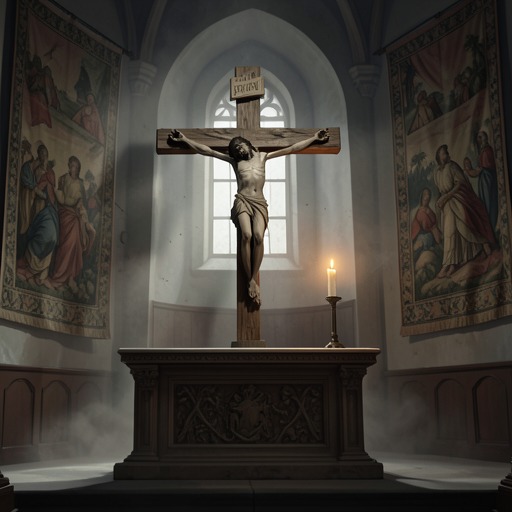
The altarpiece stands at the end of the church’s single nave, its central figure of the Virgin beneath a broad baldachin above the tabernacle. Images of saints and cherubs occupy niches in the lateral sections, divided by carved columns; the arrangement brings sculptural figures, architectural forms, and ornamental motifs together as one densely worked surface. Initially dimmed by scaffolding and shadow, the ensemble is transformed when Gris Marsala switches on its lights: gilded surfaces catch the brightness, which spreads among columns, medallions, and delicately carved garlands.
Lorenzo Quart responds first with unguarded admiration, then instinctively makes the sign of the cross. The gesture surprises Gris, who observes that the clergy who once stood before this altarpiece belonged to another kind. The exchange establishes a tension that runs through the object’s presentation: the altarpiece can command reverence through its visible beauty even when the faith and habits associated with it have become matters of doubt or historical distance.
Gris identifies the work as a product of the Seville Baroque of the eighteenth century and calls it a small jewel falling to pieces. She dates its creation to 1711 and says Duque Cornejo was paid two thousand escudos, each worth eight silver reales. Her account presents the altarpiece as an ambitious expression of Baroque imagination and daring, but also as part of a church whose restoration has nearly stalled for want of approved budgets and arriving funds. The splendor is real; so is the neglect surrounding it.
The Virgin and the Bruner Foundation
At the ensemble’s center is a nearly meter-high polychrome wooden Virgin, dressed in a blue mantle, hands open with palms outward. A crescent moon serves as her pedestal, and her right foot crushes a serpent. Quart calls the figure beautiful. Gris adds that the image originally wore smaller glass beads, later replaced by twenty perfect pearls brought from America near the end of the nineteenth century, connecting the altar’s devotional image to a separate story associated with the church’s crypt.
The altarpiece also records the circumstances of the church’s foundation. The crypt, concealed to the right of the high altar, holds generations of the dukes of the New Extremadura. Gris explains that Gaspar Bruner de Lebrija gave the land for the church in 1687 on the condition that Mass be said for his soul once each week. The altarpiece includes carved likenesses of Gaspar and his wife: Duque Cornejo made both the praying figure of the donor and the figure representing his wife. Their son Guzmán Bruner paid for the completion of the altarpiece and brought the Virgin’s image in 1711. The artwork thus joins the church’s sacred function to the family’s patronage and continuing, though diminished, connection with the building.
Worship, Repetition, and Consolation
The altarpiece is not merely looked at; it provides the visual focus for a repeated ritual. At a morning Mass, Quart sees Príamo Ferro celebrate beneath it while about twenty parishioners occupy half the nave. The church remains under repair, with many benches and kneelers stacked against the walls and scaffolding interrupting the interior. Against that unfinished setting, the lit altar and the familiar movements of the service give the congregation a stable center.
Ferro’s celebration preserves older forms. He wears an amice beneath his vestments, and his worn guitar-shaped chasuble belongs to a style largely displaced by lighter garments. He also says in Latin those parts of the Mass not addressed directly to the congregation or recited collectively, despite the post–Vatican II rule that parish Mass be celebrated in the local language to encourage understanding and participation. The service therefore makes the altarpiece part of a broader encounter between inherited religious forms and ecclesiastical modernization.
Quart’s response changes as he watches. Although skeptical and initially scornful of Ferro, he is moved by the priest’s solemn gestures before the gilded Virgin. The service’s importance, he realizes, is not exhausted by the question of whether God exists or intervenes: the faces turned toward the altar are receiving consolation, a sense of warmth against cold and companionship in darkness. The altarpiece’s visual richness and the Mass’s repeated words and actions help make that consolation tangible to the people gathered beneath it.
The Thursday Mass and the Church’s Survival
The foundation’s weekly obligation acquires urgent force in the dispute over the church. Nuestra Señora de las Lágrimas is considered untouchable while Mass is said for Gaspar Bruner’s soul every Thursday, the day of his death in 1709, at eight in the morning. A representative of the archbishop and a notary paid by Pencho Gavira watch the service for an irregularity or omission. The ritual is consequently both worship and a condition on which the building’s protection depends.
The condition explains why Ferro’s routine matters beyond the altar. He celebrates Mass every day except Sundays and holy days, when he celebrates twice; on Thursdays, the family’s founding arrangement and the threat of demolition make the service especially consequential. Macarena Bruner fears that, with Óscar Lobato away, someone may try to act against Ferro. If a priest failed to celebrate or omitted the required formula, the church could be condemned to demolition, giving the archbishop and Banco Cartujano the advantage in the redevelopment struggle. The altarpiece stands at the center of this conflict not as a legal instrument in itself, but as the visible focus of the Mass whose continuity safeguards the church.
A Baroque Image of Faith Under Pressure
Ferro interprets the church’s Baroque character as an instrument of religious consolation. He associates its lavish altars, gilding, and emotionally charged images with an art that asks worshippers to behold rather than analyze, offering hope against the fear that life ends in death and oblivion. He defends the existence of the church on the grounds that those who come to it still have faith, even while acknowledging uncertainty about his own. Quart challenges the consoling power of this approach as a possible form of alienation, but the Mass has already shown him why its effects cannot be reduced to an argument about doctrine.
That difference gives the altarpiece its layered significance. It is an artwork vulnerable to the same neglect as the church around it, a memorial to the family that endowed the building, and the radiant focus of a ritual that comforts parishioners and protects their place of worship. Its gold does not resolve the conflict between belief and doubt or between preservation and redevelopment. Instead, it holds those conflicts together in a single setting where beauty, inherited obligation, and the need for consolation continue to meet.